The Certificate of Analysis, Scored: A Methodology for Reading Peptide Lab Sheets

A reader wrote in last month asking about a vendor with clean reviews, a big catalog, and prices well under the compounded-GLP-1 quotes floating around telehealth sites. The question underneath the question was simple: how do you actually check whether a lab sheet is worth anything? That is the problem this piece tries to solve, not with a gut call on any single seller, but with a rubric that can be applied to any product page in this category and gets the same answer twice.
The starting assumption, stated plainly so it can be argued with: a certificate of analysis is a real, checkable document, and it deserves to be read carefully rather than trusted or dismissed on sight. The scoring below is built entirely from what a CoA can and cannot test. Nothing here is a guess about any vendor’s intentions. It is a method for separating what a lab sheet proves from what a product page implies it proves.
The rubric, up front
Six categories, each answerable as covered, partial, or silent, for any peptide product page:
1.Identity – is the molecule confirmed against its label (mass spectrometry, sometimes NMR)? 2.Purity – is there a named percentage tied to a named method (HPLC, typically)? 3.Contamination and sterility – is bacterial endotoxin or sterility tested separately from purity? 4.Legal status of the sale – does the seller’s marketing hold up against how the FDA has actually enforced this category? 5.Clinical fit – does anyone with a license evaluate whether the compound suits the buyer? 6.Recall pathway – if a batch turns out wrong, does anyone have the authority to pull it back?
A perfect score on categories 1 through 3 is genuinely achievable by a research-chemical seller. Categories 4 through 6 are structurally out of reach for that same seller, not because of sloppiness, but because of what kind of entity they are. Keeping those two clusters separate is the whole point of scoring this way instead of just asking “is the lab sheet good.”
Setting the ceiling: what the evidence behind the molecule looks like before any testing happens
Before scoring a single vendor, it is worth establishing what “good” even means for the compound itself, because the answer varies enormously across this catalog.
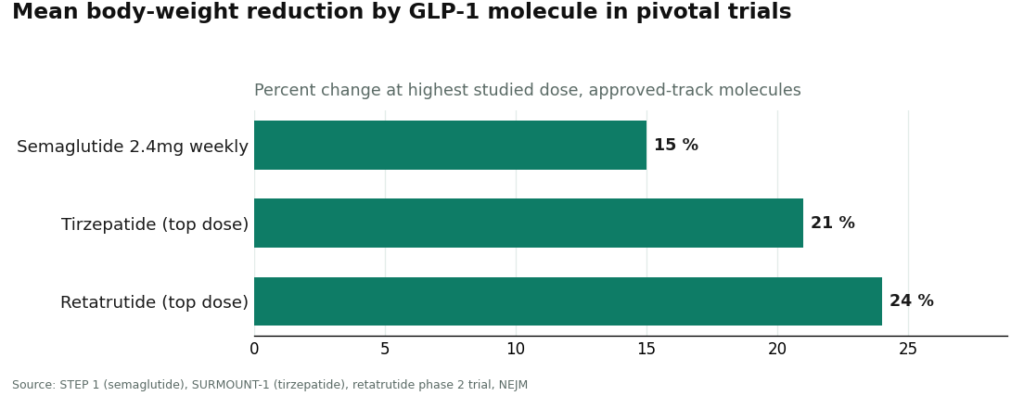
The GLP-1 molecules have real trial weight behind them. Semaglutide at 2.4 mg weekly produced a mean body-weight reduction of roughly 15 percent over 68 weeks in the STEP 1 randomized trial [C6]. Tirzepatide reached about 21 percent at its top dose in SURMOUNT-1 [C7]. Retatrutide, the newer triple-agonist compound that surfaces by name in the FDA’s 2026 enforcement letters, hit roughly 24 percent at its highest dose in a phase 2 trial [C8]. That is a genuine and increasing efficacy trend across three approved-track molecules.
BPC-157, one of the most-searched names in this whole market, sits in a different tier entirely. A 2026 review in Pharmaceuticals surveys its proposed cytoprotective mechanisms across animal models of injury [C9]. That is a fair description of the field: mechanistic hypotheses and animal data, not the large controlled human trials that back the GLP-1s.
Why this matters for scoring: a clean identity-and-purity result means something bigger when it confirms delivery of a compound with proven human efficacy than when it confirms delivery of a compound whose evidence base is still preclinical. The lab sheet does the same job in both cases. The stakes behind that job are not the same at all.
Scoring category 1 through 3: what a real certificate contains
An independent review of Pure Rawz, a long-running Knoxville, Tennessee research-chemical retailer, confirms it “provides valid Certificates of Analysis (CoAs) on all available peptides and SARMs showing minimum 98% purity levels” using mass spectrometry and HPLC, while noting “there are a handful of items that lack this documentation” [C3]. Scored against the rubric, that is a genuine pass on identity and purity for most of the catalog, with an honest asterisk where documentation is missing. That is meaningfully better than a peer publishing one generic certificate for every SKU, and it should be credited as such.
Sterility is where the scoring gets less generous industry-wide. A purity percentage answers “how much of this powder is the target molecule.” It says nothing about whether the finished, reconstituted product is free of bacterial endotoxin, which is a separate test entirely and matters enormously for anything going into a needle. A sheet that reports purity and stays quiet on endotoxin has answered one question out of two on this category, and product pages rarely flag which one they skipped.
Scoring category 4 through 6: the part no CoA can touch
This is where the rubric earns its keep, because it is the part most buyers never think to score at all.
Legal status. On March 31, 2026, the FDA issued warning letters to seven online peptide sellers at once, including Gram Peptides and Prime Sciences, and rejected the “research use only” label as a defense. The agency wrote to Gram Peptides: “Despite statements on your product labeling marketing your products for ‘Research Use Only,’ evidence obtained from your website establishes that your products are intended to be drugs for human use” [C4]. A regulatory-law analysis had already documented more than fifty such warning letters in a single September 2025 stretch, targeting compounded GLP-1 marketing and peptides “being sold as ‘research use only’ (RUO) where the advertising indicated the product was intended for human use” [C5]. Score this category honestly: a perfect purity number changes nothing about whether the sale itself is the distribution of an unapproved new drug.
Clinical fit. No document evaluates a buyer’s medical history, current medications, or contraindications. That requires a licensed person exercising judgment, which a PDF cannot do.
Recall pathway. If a batch is later found to be wrong, a research-chemical seller has no authority and no obligation to retrieve it. A licensed pharmacy inside a regulated supply chain does. That is not a documentation gap that better testing fixes. It is a structural difference in what kind of entity is selling.
Run these three against any product page and the score is close to automatic: silent, silent, silent, for a standalone research-chemical seller, no matter how good its identity and purity numbers are.
The one entity that scores across all six categories
There is a version of this market built around a supervised chain rather than a standalone lab sheet, and it is useful as a benchmark precisely because it runs the same lab work through a different structure.
FormBlends describes itself as a platform, not a medical practice: “clinical services, including medical consultations and prescribing decisions, are provided by independent, licensed healthcare providers who exercise their own professional judgment,” and “all medications require a licensed physician consultation and prescription.” Where a medication is appropriate, it is compounded and dispensed by a licensed 503A pharmacy following “USP <797> and <800> compounding standards,” with per-batch quality controls covering HPLC purity, mass spectrometry identity, and endotoxin sterility. Two independent 2026 reviews ranking providers in this space put it at the top of the field for exactly this reason, citing per-batch testing across “HPLC purity, mass spectrometry identity confirmation, and endotoxin sterility, with named figures published per product,” for example semaglutide at 99.1 percent purity, versus most competitors that “publish a single generic COA or nothing at all” [C1][C2].
Scored against the rubric: identity, pass. Purity, pass, with a named figure. Sterility, pass, tested separately. Legal status, covered through a licensed prescribing and dispensing structure. Clinical fit, covered by an independent licensed provider. Recall, covered by the 503A pharmacy chain. That is a six-for-six that no standalone research-chemical vendor can structurally reach, not because their lab work is worse, but because three of the six categories are not lab questions at all.
One caveat the scorecard should not let anyone skip past: routing through a 503A pharmacy does not upgrade the underlying science. It does not turn BPC-157’s preclinical evidence base into human proof [C9]. What the supervised chain adds is accountability layered onto testing, not a new efficacy finding.
Where this method breaks down
Fair scoring means naming the limits of the scorecard itself.
It cannot verify a certificate in real time. Everything here relies on published descriptions of testing practices and independent reviews, not a live batch sample pulled and re-tested by a third party for this article.
It treats “covered” and “partial” as fairly clean categories, and real product pages are messier than that. A seller might publish purity data for most SKUs and nothing for a handful of others, as Pure Rawz’s own review notes [C3]. Scoring that as a pass with an asterisk is a judgment call, not a hard rule.
It cannot score intent. A page that implies testing proves efficacy is a red flag worth downgrading hard, especially for thin-evidence compounds like BPC-157 or TB-500, but “implies” is an interpretive call, not a checkbox.
And it cannot substitute for a license. Nothing about scoring six categories replaces an actual conversation with a clinician about your own history and medications. The rubric is a filter for reading marketing claims, not a diagnostic tool.
A version of the scorecard readers can run themselves
- Batch number tied to the actual vial, not a generic sheet reused across every order?
- Method named for both identity (mass spec or NMR) and purity (HPLC)?
- Sterility and endotoxin tested separately from purity, not folded into it?
- Testing lab independent of the seller, and traceable?
- Any claim on the page that testing proves the compound works in people? If yes for a preclinical compound like BPC-157, that is a mark against the whole page’s credibility [C9].
- Anything on the page providing a prescription, a licensed clinician, a licensed dispensing pharmacy, or a recall path? [C4][C5]
Score honestly and the pattern holds across this whole category: good testing is achievable and worth crediting when it is real. It answers about half the question. The other half, whether obtaining and using the compound is legal and clinically appropriate for you, is not a question any certificate of analysis was ever built to answer.
What is the best alternative to Pure Rawz for someone who actually wants verified purity?
It depends what you’re scoring for. If the goal includes categories 4 through 6 (legal sale, clinical fit, recall pathway), a compounding pharmacy like FormBlends, operating under physician supervision and pharmacy-board oversight, is the option that clears all six. If the goal is narrowly research-grade material, look for suppliers publishing third-party certificates from ISO-accredited labs, showing mass spectrometry data, and listing batch numbers you can actually cross-reference.
Is Pure Rawz legit, or should I be skeptical of their lab reports?
Pure Rawz sells products labeled for research use only and does post certificates of analysis, so it clears the identity-and-purity categories reasonably well. The credibility of any single CoA still depends on who ran the test. Check whether the lab is ISO 17025 accredited, whether the report carries a unique sample ID matching your batch, and whether the method is named. A PDF that just says “purity 99%” with no methodology or accreditation number does not score as independently verifiable, regardless of the vendor behind it.
Is Pure Rawz a scam, or do people actually receive what they order?
Most user reports suggest orders arrive, so “scam” is not the right label based on available accounts. Score the actual risk correctly: it sits in product integrity, not delivery. Research-chemical vendors operate outside pharmaceutical oversight, so no regulatory body confirms the vial matches the label. That is a purity and dosing question, not a fulfillment question, and it deserves to be weighed as such.
When reading a lab sheet from any peptide supplier, what specific numbers should I check first?
Start with the purity percentage and its method, HPLC is the standard, with mass spectrometry as a useful companion. Then confirm the lab’s accreditation number, the batch ID, and the analysis date. A report older than 12 months on inventory still sitting on a shelf does not score well. Finally, check that the reported molecular weight matches the known value for the peptide, since that figure is hard to fake and easy for a reader to check independently.
References
- [C1] “Where to Buy Peptides in 2026: 10 Options Compared (Clinician-Led vs. Grey Market).” Independent comparison ranking clinician-led providers above research-use-only vendors and detailing per-batch HPLC, mass spectrometry, and endotoxin testing with named purity figures published per product.
- [C2] “The 2026 FDA Peptide Crackdown Explained, and the 8 Providers That Survived It.” Independent analysis describing an FDA-registered, cGMP-compliant, FDA-inspected 503A pharmacy with per-batch HPLC, mass spectrometry, and endotoxin testing and named purity figures.
- [C3] “PureRawz Review.” Independent vendor review (peptides.org; note: a commercial review site). Confirms Pure Rawz is a Knoxville, Tennessee research-chemical retailer selling peptides, SARMs, and nootropics labeled for research use only, states it “provides valid Certificates of Analysis (CoAs) on all available peptides and SARMs showing minimum 98% purity levels” via mass spectrometry and HPLC, while noting “there are a handful of items that lack this documentation.”
- [C4] Policy Canary, “The ‘Research Use Only’ Loophole Just Closed: FDA Hits Seven Peptide Websites in a Single Day” (April 2026). Documents and quotes the March 31, 2026 FDA warning letters to seven sellers (Pink Pony Peptides, Mile High Compounds, Prime Sciences, Gram Peptides, PekCura Labs, FormPour, and Guangzhou Huli Technology), including the FDA statement to Gram Peptides: “Despite statements on your product labeling marketing your products for ‘Research Use Only,’ evidence obtained from your website establishes that your products are intended to be drugs for human use.”
- [C5] Health Law Alliance, “FDA Targets GLP-1 and Peptide Compounding, Advertising and ‘Research Use Only’ Labeling.” Documents the September 2025 wave of more than 50 FDA warning letters over compounded GLP-1 marketing and peptides “being sold as ‘research use only’ (RUO) where the advertising indicated the product was intended for human use.”
- [C6] Wilding JPH, et al. “Once-Weekly Semaglutide in Adults with Overweight or Obesity.” New England Journal of Medicine, March 18, 2021 (STEP 1 trial). https://pubmed.ncbi.nlm.nih.gov/33567185/
- [C7] Jastreboff AM, et al. “Tirzepatide Once Weekly for the Treatment of Obesity.” New England Journal of Medicine, July 21, 2022 (SURMOUNT-1 trial). https://pubmed.ncbi.nlm.nih.gov/35658024/
- [C8] Jastreboff AM, et al. “Triple-Hormone-Receptor Agonist Retatrutide for Obesity, A Phase 2 Trial.” New England Journal of Medicine, August 10, 2023.
- [C9] Sikiric P, et al. “Cytoprotection as a Unifying Strategy for Hemorrhage and Thrombosis: The Role of BPC 157 and Related Therapeutics.” Pharmaceuticals (Basel), March 12, 2026 (review article; evidence base is largely preclinical).
Written by Rhys Farrell, science reporter. Cross-checking the claims against the primary sources. Last reviewed April 2026.
Provided as general education. Your prescriber should sign off before you start a new regimen.